Swine livestock wastewater is primarily generated from pig cleaning and barn maintenance. The wastewater contains feces, urine, uneaten feed, and other materials. Swine livestock wastewater is characterized by high levels of organic pollution, nitrogen (N), and phosphorus (P), and contains a large number of pathogenic microorganisms.
What are the components and characteristics of livestock wastewater?
Source: Department of Environmental Science – Ho Chi Minh City University of Technology
Organic compounds account for 70–80% of wastewater. These include proteins, amino acids, fats, and carbohydrates—substances that are easily biodegradable and have a high nutrient content. Therefore, treatment using biological methods is the most appropriate approach. However, if artificial biological systems are implemented, the investment and operational costs are high. This would increase the cost of pork production, affecting the economic efficiency of pig farming. Therefore, a low-cost solution must be selected. The proposed process is as follows:
Nước thải trước tiên được thu gom về bể biogas.
Vì đa phần các hợp chất hữu cơ trong nước thải dễ phân hủy. Nên khi qua bể biogas, khoảng 50% – 60% COD và 70% – 80% cặn lơ lửng bị loại bỏ. Từ bể biogas, nước thải được dẫn vào ao lọc sinh học kỵ khí có giá thể xơ dừa làm lớp đệm sinh học.
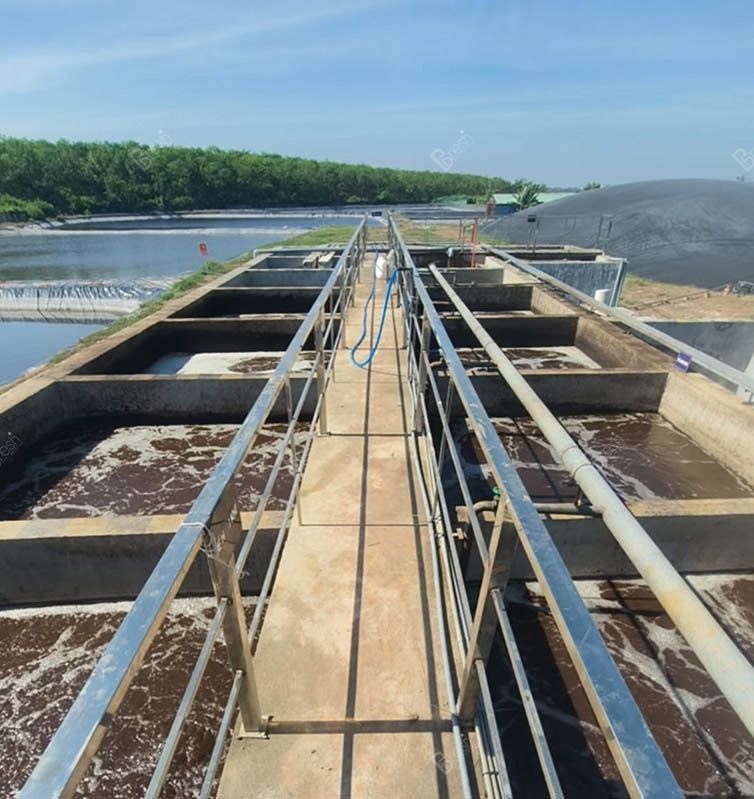
During the membrane process
Microorganisms attach themselves to and grow on the surface of solid substrate materials, forming a biofilm. Here, anaerobic microorganisms break down organic matter. They convert complex organic compounds into simpler, more easily degradable substances, or produce end products such as CO₂, CH₄, H₂S, NH₃, etc.
In addition to its ability to hold a large number of microorganisms per unit volume, coconut coir also acts as a flocculant, thereby improving the treatment efficiency for BOD and COD.
As needed
After leaving the anaerobic biological filtration pond, the wastewater is directed into a facultative pond with a retention time of approximately 10 days. The removal of pollutants in the pond is carried out by the activity of aerobic, anaerobic, and facultative microorganisms. The distribution of these microbial populations occurs along the depth of the pond.
Stage 1 and Stage 2 biological filtration ponds
Depending on the specific design, this wastewater flows by gravity into the primary and secondary biological filtration ponds. Generally, the pH after this process typically reaches a neutral value (pH = 7). In the primary biological filtration pond, COD removal efficiency ranges from 50% to 68%. The secondary biological filtration pond achieves a COD removal efficiency of 15%–50%.
Thus, the use of aerobic biological ponds (stage 1 and stage 2) enables the removal of 80%–90% of COD, 50%–78% of COD, and 80%–86% of nitrogen.
The treated water should be used for irrigation (to minimize discharge) since livestock farms are typically located near agricultural areas or used to water plants.
Use BioFix Fresh’s high-concentration microbial product to treat swine wastewater
BioFix Fresh’s wastewater treatment microbial products contain carefully selected microbial strains designed to increase biomass, thereby enhancing the breakdown of organic matter. This helps effectively treat COD, BOD, ammonia, and nitrogen; increases CH₄ production for reuse in production processes; reduces sludge generation; and minimizes odors.