Foaming in aerobic biological reactors is a common problem in many wastewater treatment systems. The foam is typically sticky, viscous, and discolored. It floats and accumulates on the surface of the tanks, thereby reducing effluent quality and affecting sludge retention time.
Foam can also spill onto walkways and surrounding areas, causing serious difficulties and risks to operations and the environment. So, why does foam form in wastewater systems? Let’s find out with BIOFIX FRESH!
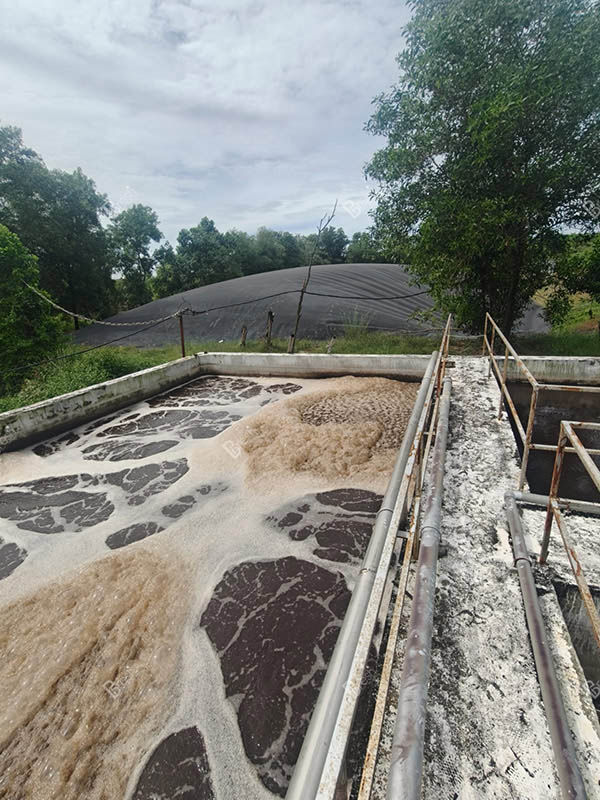
The foam is white
The foam is white and large, and it gradually increases until it covers the entire surface of the tank.
White foam floating in the aerobic bioreactor
Reason:
- During the initial phase of microbial cultivation, due to loading shock, the flow rate of the wastewater being pumped in needs to be adjusted.
- The amount of active microorganisms in the treatment tank is too low (less than 10% MLSS, i.e., MLSS < 1000 mg/L)
- Due to the high concentration of organic matter in the aerobic biological treatment tank (the COD value in the activated sludge tank exceeds the treatment capacity of aerobic microorganisms by many times (COD > 1200 mg/L)).
- An improper sludge discharge regimen gradually leads to low microbial concentrations in the tank, resulting in overloading.
So, how do you fix it?
- We monitor the microbial concentration in the biological reactor by measuring SV30, pH, and DO. If the sludge continues to settle normally and the SV does not increase or decrease, this may be due to a high concentration of surfactants in the incoming wastewater. In that case, we should aerate and agitate the system for 30 minutes to 1 hour; the foam will gradually subside and eventually disappear. Typically, the pH of the wastewater is ≥ 8.
- If the SV30 is below 150, you need to replenish the microorganisms in the aerobic tank by adding more microbial inoculant. Additionally, you can reduce the flow rate of the wastewater being pumped in to allow the microorganisms to grow and recover.
The foam is yellowish-brown
The foam is yellowish-brown in color, resembling activated sludge at that time. The foam is fragile and contains fine particles of activated sludge, so it does not accumulate significantly over a short period of time and does not generate a large amount of waste. Filamentous bacteria are present.
Brownish-yellow foam floating in the aerobic bioreactor
There are two reasons
- Due to fats and oils: the foam is brownish-yellow, sticky, and has a foul odor.
- As the microorganisms die, they release foul-smelling substances that form air bubbles on the surface of the water tank. This causes the sludge to become oxygen-deprived, die, and then cling to the air bubbles.
So, how can this be fixed?
Immediately: we turn off the aeration and skim off the foam.
Long-term:
- Strictly control the amount of fat added. Then add probiotics.
- Let it settle for about an hour, then pump out the wastewater. Next, pump clean water into the aerated Aerotank and aerate it for about 30 minutes, then let it settle again and pump it out once more.
- Immediately take steps to preserve the remaining active microorganisms by turning off the aeration system and allowing the tank to settle for one hour; then pump clean wastewater into the aerated Aerotank, aerate for 30 minutes, allow it to settle, and continue pumping the water out.
The foam is grayish-black
The foam is dark gray and fragile. The color of the biochemical activated sludge is also slightly gray. There is the presence of foam-forming bacteria, a low F/M ratio, and aged sludge.
Grayish-black foam floating in the aerobic bioreactor
The cause is that the activated sludge has lost its activity (becoming very fine) due to a lack of nutrients for the microorganisms. Since the microorganisms lack food, the activated sludge does not grow and becomes very fine.
Solution
Increase the feed rate for microorganisms by
- Increase the flow rate of water to be treated
- Add natural organic matter to promote microbial growth