What is an Aerotank? An Aerotank (also known as an aerobic biological reactor) is a tank used in the process of artificial aerobic biological treatment. The Aerotank operates using wastewater-treating microorganisms capable of oxidizing and mineralizing the organic matter present in wastewater. In the Aerotank, organic waste is broken down by beneficial microorganisms, which use this organic matter as a nutrient source for their growth and development.
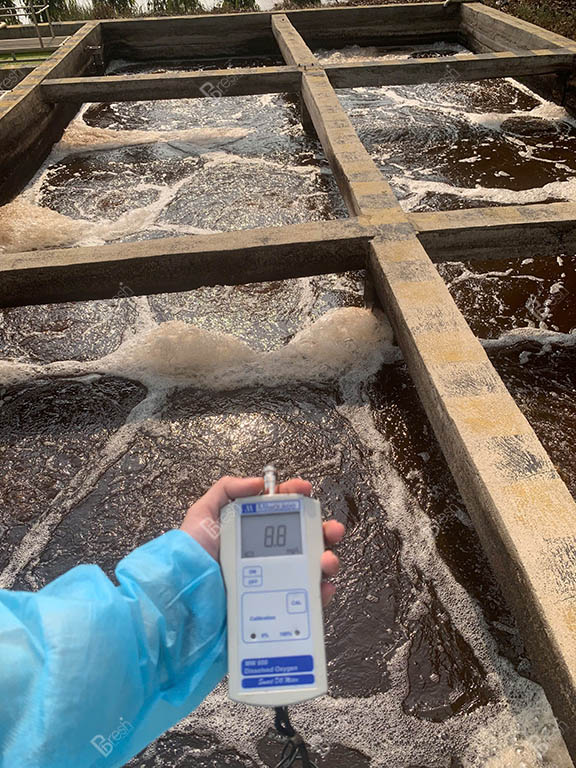
Bể Aerotank
How the Aerotank works:
The Aerotank operates based on the following three basic processes:
First is the oxidation of organic compounds:
This process can be described by the following equation:
CxHyOz + O2 — Enzyme —> CO2 + H2O + H
During this phase, activated sludge forms and grows rapidly. The higher the oxidation rate, the faster oxygen is consumed. At this point, the nutrient content in the wastewater is high, resulting in very rapid microbial growth. Consequently, oxygen demand in the Aeroten tank is very high.
The process of new cell synthesis
CxHyOz + NH3 + O2 — Enizyme —> CO2 + H2O + C5H7NO2 – H
In this second stage, the microorganisms have stabilized, and their oxygen demand has not changed significantly. It is also during this stage that the greatest amount of organic matter is broken down. At the same time, enzyme activity in the activated sludge reaches its peak.
The process of intracellular degradation
C5H7NO2 + 5O2 — Enzyme —> 5CO2 + 2H2O + NH3 ± H
During this phase, the rate of oxygen consumption in the tank continues to rise. According to the operating principle of the Aerotank, this phase is when ammonium salts are nitrified. Immediately afterward, the demand for oxygen begins to decrease again.
When operating the Aerotank, note that if approximately 80–90% of the oxidation process has occurred without proper mixing, the activated sludge will settle at the bottom, requiring time to remove the sludge from the water. If the sludge is not separated in time, the water in the tank will become contaminated.
Classification of aerotanks:
Currently, the Aerotank aerobic biological filter market is divided into the following types:
- Traditional Aerotank
- Multi-stage high-capacity Aerotank
- The Aerotank has a compartment in contact with stabilized activated sludge
- Extended-aeration Aerotank
Advantages and disadvantages of the Aerotank:
Advantages of the Aerotank aerobic tank:
The Aerotank aerobic reactor effectively removes organic matter, helping to minimize foul odors and reduce pollution from wastewater and waste. The wastewater treatment process using the Aerotank reactor removes inorganic phosphorus and eliminates many pathogens in agricultural wastewater, resulting in water that is safe for the environment.
Not only that, but another advantage of the Aerotank is its ability to stabilize sludge levels and remove approximately 97% of suspended solids.
Given the treatment efficiency of the Aerotank described above, the Aerotank aerobic biological reactor has now become the most widely used and popular wastewater treatment method on the market.
Disadvantages of the Aerotank:
To operate an Aerotank, staff and technicians must receive thorough, professional training, as these systems are highly technical. If one of the treatment stations malfunctions, the treated wastewater will still have a significant impact on the environment and remain highly toxic. This process does not remove the color from industrial waste; in fact, it can even intensify its color.